J. L. BELL is a Massachusetts writer who specializes in (among other things) the start of the American Revolution in and around Boston. He is particularly interested in the experiences of children in 1765-75. He has published scholarly papers and popular articles for both children and adults. He was consultant for an episode of History Detectives, and contributed to a display at Minute Man National Historic Park.

Subscribe thru Follow.it


•••••••••••••••••


Showing posts with label John Adams. Show all posts

Sunday, August 09, 2026

“The Women from the Windows asking Davis whether he wanted any Gingerbread”

Massachusetts ships captured the Peggy on its voyage from Halifax to New York on 22 July 1776, as described yesterday.

The civilians aboard that ship were taken to Marblehead, then to Boston under guard. Word spread quickly that one of them was Benjamin Davis, a merchant who had left town months before.

On 28 July, Joseph Ward wrote to John Adams from Boston about the ship: “There are many Tories on board, among whom is the noted Benjamin Davis.”

The next day, Ezekiel Price put in his diary: “Brought to town Benjamin Davis and a number of other Tories, who were committed to jail.”

Why was Davis being singled out? He’d made himself notorious in some way, and we have a couple of hints about how.

David Cobb wrote to Robert Treat Paine on 29 July:
Just now the Tories were Landed at the Long Wharf from Marblehead & were attended from thence to the Prison by 2 thousand people; the Women from the Windows asking Davis whether he wanted any Gingerbread, refering to his treatment of the little Chreldren when they were going out of Town last Year. I wish the Devil had ’em.
Abigail Adams alluded to the same scuttlebut in her letter to John the same day:
we have taken a vessel from Halifax bound to New York, which we should call a prize but that it containd about 14 Tories among whom is that infamous Wretch of a Ben Davis the Ginger Bread Robber. How many little ones can say I was an Hungry and you gave me no Bread, but inhumanely took what little I had from me. I wish the Sea or any other Element had them rather than we should be tormented with them.
The editors of the Adams and Paine Papers weren’t sure what to make of those remarks about gingerbread.

I can’t find any sources providing a definite answer, but here’s my guess. At the start of the war, many families sought to leave Boston. Gen. Thomas Gage didn’t want refugees to take out food, which his army needed, or weapons, which the provincial army needed. So the governor set up a system of passes and inspections using both military and civilian administrators.

In the 5 June 1775 Boston Gazette, Benjamin Edes published an open letter addressed “To the perfidious, the truce breaking THOMAS GAGE” and signed “Massachusettensis.” (This was not, presumably, the Loyalist political writer.) Among its complaints about Gage was:
Nay, have not you, and your associates by your orders, been mean enough to steal rum and sugar from a poor teamster, half a cake of gingerbread, a nutmeg, and half a bisket from a poor woman who was flying half famished out of Boston from your low lived tyranny and oppression?
That item was reprinted in several other Massachusetts and Connecticut newspapers over the next couple of weeks. It’s the one gingerbread-related complaint I could find from the period.

That complaint shows that people working for the royal government were confiscating food from folks trying to leave Boston, even mundane food like gingerbread, even from “a poor woman.”

I suspect that Benjamin Davis had agreed to work for Gage’s royal government as some sort of inspector or administrator. At some point that spring, he took gingerbread from a family or two trying to leave town. Children may have cried. That incident didn’t get into the newspapers, but it made him notorious enough that citizens yelled at “Ben Davis the Ginger Bread Robber” more than a year later.

And, unlike Hopestill Capen, few people in Boston minded seeing Davis locked up.

(The picture above shows the Pennsylvania politician Joseph Galloway, not mentioned anywhere in this posting. In September 1774 John Adams wrote in his diary that he was “introduced to Mr. Galloway, the Speaker of the House in Pensylvania. He looks like Ben. Davis the Sandimanian.”)

Monday, August 03, 2026

“So disagreeable that one half of the Congress withdraw”

Delving into the newly published John Dickinson letters also led me back into the notes of the Continental Congress during 1775.

The official record that secretary Charles Thomson kept for eventual publication was often anodyne. The delegates made themselves into a committee of the whole to avoid going on the record, and of course Thomson was politic about what he recorded.

But some delegates kept their own notes. In this period Silas Deane kept busy summarizing arguments and then grading the speakers.

Neither Dickinson nor John Adams came off in Deane’s notes as so composed and effective as they would have liked.

In his memoir Adams described himself as “not having ever been remarkable for very long Harrangues.” But on 15 May Deane described the Massachusetts man’s remarks as “lengthy, and argumentative.”

Dickinson felt he was guiding the Congress to a safe middle course. That same day Deane wrote that the Pennsylvanian “argues smoothly but Sophistically on the Subject and gives rather disgust.”

And here’s the delegates’ interactions on 24 May:
Mr. Dickinson in his old Way lengthy, and concludes in his old Way with a Fable

Mr. [Thomas] Mifflin animadvests[?] with spirit on him and exposes his reasoning &c

Mr. [Thomas] Johnson, on a reconciling plan and offers a Motion.

Col. [Richard Henry] Lee for a different mode of expression in ye Motion and is severe on Dickenson

Mr. Jno. Rutledge against any Concession whatever, that Lord North has given Us his Ultimatum with which We cannot agree. Treats Dickinsons plan with the upmmost Contempt. and is so severe that [Samuel] Chase rises to explain himself.

Col. Lee up again

Mr. [Thomas] Stone of Maryland so disagreeable that one half of the Congress withdraw
Deane’s 1775 notes were published in Letters of Delegates to Congress, and they can easily be found online at From the Page and American Founding.

Meanwhile, the Congress’s official record of 24 May 1775 is:
Peyton Randolph, President, returned to Virginia where he was Speaker of the Assembly. John Hancock was unanimously chosen President.

Samuel Ward reported that the committee of the whole had made progress in the business of the state of America, but not having come to a conclusion, requested permission “to sit again.”

Adjourned till to Morrow at 9 o’Clock.
Deane’s notes show what was really behind that “progress.”

Sunday, August 02, 2026

“Dependant upon the Imperial Crown of Great Britain”?

In 1775, John Adams and John Dickinson held the same basic position about the best course for the British Empire and its large North American colonies:
  • There must be a new understanding of the relationship between those colonies and the central government in London.
  • But those colonies need not become independent.
The problem was that the two men defined “independent” differently.

On 15 May, Silas Deane made these notes on the Continental Congress’s debate:
Mr. Jno Ruttlidge…insists it previously some that points must be settled, such as do We aim at independancy, or do we only ask for a Restoration of Rights & putting of Us on Our old footing. speaks long & well

Mr. Robt. R Livingston Succeeds him in the same way. short

Mr. Jno. Adams lengthy, and argumentative. independance on Parliamant is absolutely to be avowd. in the Americans, but a dependance on the Crown is what We own
Adams thus declared himself in favor of “independance” only from Parliament, not the entire British system (“the Crown”). How exactly that would work he didn’t say.

Two months later, in his letter to James Warren that fell into British hands, Adams went into more detail:
We ought to have had in our Hands a Month ago, the whole Legislative, Executive and Judicial of the whole Continent, and have compleatly moddelled a Constitution, to have raised a Naval Power and opened all our Ports wide, to have arrested every Friend to Government on the Continent and held them as Hostages for the poor Victims in Boston. And then opened the Door as wide as possible for Peace and Reconcilliation
Adams still didn’t use the term “independance.” He still held out the prospect of “Reconcilliation.”

To Dickinson, however, Adams’s wish list amounted to “a total Independence, & the Establishment of a Commonwealth.” The term “commonwealth” recalled the English protectorate of the mid-1600s, which Adams’s Puritan ancestors had applauded but most British subjects remembered with distrust.

Adams never saw the material that Dickinson sent to David Barclay in Britain in August 1775. In fact, hardly anyone in the history of the world saw those documents until they were just published in the William & Mary Quarterly. With his letter Dickinson included draft legislation he hoped would calm the crisis by resetting the imperial relationship to how it had been back before Parliament started raising tariffs in 1763.

But Dickinson prefaced part of that legal repeal with this language:
Whereas it is essential to the good Government & Prosperity of every Sosciety [sic] or State, that an undisputed Supreme superintending Power & Authority should exist within it; And whereas this Power & Authority hath always been vested in & exercised by Parliament; and whereas the respective local legislatures of distinct Colonies are in many Instances incompetent; be it therefore further enacted by the Authority aforesaid, that when any of the said Colonies shall by an Act of Assembly acknowledge & recognize & declare the said Colony to be dependant upon the Imperial Crown of Great Britain, and that the Kings most excellent Majesty by & with the Advice & Consent of the Lords Spiritual & temporal & Commons in Parliament assembled had hath & of Right ought to have full Power & Authority to make Statutes to bind the People of the said Colonies, where the general Wellfare of the Whole Empire shall require the Exercise of such a Supreme superintending Power & Authority, as especially to make Statutes for regulating the Trade & Navigation of the Whole Dominion of the Imperial Crown of Great Britain…
To Adams, Dickinson’s concession would have amounted to accepting dependence on Parliament.

Ironically, both men claimed that the disclosure of Adams’s letter was useful because it showed how far he wanted to go. Dickinson felt those words should make politicians in Britain realize that some Americans sought de facto independence. Adams felt the same words emboldened more Americans to adopt his position.

In fact, none of the documents I’ve been discussing—Adams’s intercepted letter, Dickinson’s two letters to Barclay and his draft legislation—made any difference in London. On 23 August, before those papers could cross the Atlantic, King George III issued a proclamation written by Lord Dartmouth that the North American colonies were in “open and avowed rebellion” and his forces should “use their utmost endeavours to withstand and suppress such rebellion.”

Saturday, August 01, 2026

“The last Words which ever passed between Mr. Dickinson and me”?

The discovery of John Dickinson’s 28 Oct 1775 letter to David Barclay, quoted yesterday, lets us assess his thoughts on John Adams’s private criticism of him in an intercepted letter earlier that year.

As Jane E. Calvert writes in the July 2026 William & Mary Quarterly, it should also make us reassess Adams’s recollection of how he came to make that criticism. We know that other passages from Adams’s nineteenth-century memoir contradict contemporaneous sources, or at least aren’t supported by them.

According to Adams writing in 1805, the two men fell out during the Continental Congress’s debate over the Olive Branch Petition in the spring or early summer of 1775:
I was opposed to it, of course; and made an Opposition to it, in as long a Speech as I commonly made, not having ever been remarkable for very long Harrangues, in Answer to all the Arguments which had been urged. . . .

At this moment I was called out to the State house Yard, very much to my regret, to some one who had business with me. I took my hat and went out of the Door of Congress Hall: Mr. Dickinson observed me and darted out after me. He broke out upon me in a most abrupt and extraordinary manner. In as violent a passion as he was capable of feeling, and with an Air, Countenance and Gestures as rough and haughty as if I had been a School Boy and he the Master, he vociferated out, “What is the Reason Mr. Adams, that you New Englandmen oppose our Measures of Reconciliation…[?]”

I answered him very coolly. “Mr. Dickenson, there are many Things that I can very chearfully sacrifice to Harmony and even to Unanimity: but I am not to be threatened into an express Adoption or Approbation of Measures which my Judgment reprobates. Congress must judge, and if they pronounce against me, I must submit, as if they determine against You, You ought to acquiesce.”—These were the last Words which ever passed between Mr. Dickinson and me in private.
If Adams had made a firm, direct speech against the Olive Branch Petition, and Dickinson had gotten so upset about it, why would Dickinson be surprised to read Adams criticizing him weeks later? Why did Dickinson write that before the intercepted letter the Adams cousins had always “behav’d to Me…with the…greatest Marks of friendly Respect,” expressing “the most silken softness of public pretensions”?

Of course, a big part of the problem was Adams’s rude language, calling Dickinson a “piddling Genius” whose measures made the Congress appear “silly.” That went beyond a collegial disagreement over policy. Dickinson recognized the two men “differed in Sentiments” but thought they were still friendly and recognized they were all trying to solve the same problem.

Dickinson’s surprise might have been the result of John Adams’s own actions up to that point. He probably didn’t speak out as strongly as he remembered decades later. Calvert points out how Adams signed the Olive Branch Petition in July. Of course, that’s consistent with his later statement “Congress must judge, and if they pronounce against me, I must submit.” 

At the same time, I see indications that Dickinson and Adams were talking past each other on “independence” and what that really meant.

TOMORROW: Cross-purposes.

Friday, July 31, 2026

“So severely & so meanly attack’d from that Quarter”

On 28 Oct 1775, John Dickinson finished writing a long letter to a Quaker banker in Britain, David Barclay—one of the documents just published in the William & Mary Quarterly.

Dickinson had written most of that letter in late September, starting with his comments on what he had filed in his papers as “Letter from John Adams of Massachusetts Bay, in which he abuses Me, for opposing the Violent Measures of himself & others in Congress.”

Dickinson told Barclay:
The inclos’d Letters written by John Adams one of the Delegates from Massachusetts, were intercepted, as the Boat was passing an Arm of the Sea, and have been publish’d by General [Thomas] Gage. These are now in every Body’s Hands, and indisputably prove the high projects that are in Agitation. . . .

I did not expect that my Reputation would be so soon so severely & so meanly attack’d from that Quarter. My Compassion for the unhappy Province of Massachusetts Bay was so sincere & tender, that I truly regarded her Delegates as my Brothers; and they ever behav’d to Me, especially the two, that, I am now convinc’d, are my Enemies, with the [illegible] greatest Marks of friendly Respect.
That second Massachusetts delegate was almost certainly Samuel Adams.
Tho We differed in Sentiments, yet I suppos’d without the least Hesitation, that as We had embarqued our Lives & Fortunes in the same Bottom, We should feel a manly & liberal Indulgence for each others particular Opinions.

I have been mistaken; for under the most silken softness of public pretensions, lurk the bitterest Resentments, which can only spring from the Disappointment of selfish Designs.

This Assault so far from hurting my Character, has, if I can form any true Judgment, been of Advantage to Me. It convinces those, who before doubted—that tho I am resolved, as is testified by my public Conduct, at every Hazard to act for the Wellfare of my Country, yet I am not hurried away by the Torrent of Passions, that has swept so many at this Time from their sure Footing: but still retain the heartiest wishes for a Reunion with G[reat] B[ritain].

But another Effect of vastly more Consequence, will be deriv’d, from the Publication of those intercepted Letters. It will prove, that a total Independence, & the Establishment of a Commonwealth, are seriously thought of, and that hitherto they have been successfully oppos’d…

You will observe, no Doubt, how…the Writer of the intercepted Letters, & his party…abhorr any prospect of Accommodation, before they have got “the whole legislative, executive, and judicial of the whole Continent in their Hands, have completely modell’d a Constitution, have rais’d a naval Power, opended all Ports wide” &c that is, before they have established an independent Commonwealth.
Dickinson was repeating phrases directly from Adams’s letter, using it to show that his August warning that some Americans actually wanted independence had been well founded.

TOMORROW: Up until then…

Thursday, July 30, 2026

“He passed without moving his Hat, or Head or Hand”

The part of the newly released documents from John Dickinson getting the most attention, including a news story in the New York Times, is his detailed proposal to reconcile the British government and the colonies at the Continental Congress before they reached a permanent breaking point.

But of course I’m drawn to the juicy interpersonal gossip. Dickinson wrote the second of those letters after John Adams’s nasty private comment about him had leaked. That letter reveals Dickinson’s feelings about that slight as well as his perspective on what led up to it.

The July 2026 issue of the William & Mary Quarterly contains an essay by Dr. Jane E. Calvert about this episode. She points out that historians have relied on Adams’s recounting of the event in his memoir, even while acknowledging those recollections can’t be confirmed and flatter Adams in consistent ways. (Calvert and Jonathan Gienapp’s article about the Dickinson documents offers an accessible précis of her essay.)

I wrote about Adams’s indiscreet remark back in 2014. In short, Adams gave the young lawyer Benjamin Hichborn two letters to carry home to Massachusetts. Hichborn let those papers fall into British hands. Gen. Thomas Gage had the texts published in Margaret Draper’s Boston News-Letter on 17 Aug 1775.

Adams’s 24 July letter to James Warren included these lines:
In Confidence,—I am determined to write freely to you this Time.—A certain great Fortune and piddling Genius whose Fame has been trumpeted so loudly, has given a silly Cast to our whole Doings…
Those lines made their way back to Philadelphia. No delegate to the Congress had more money and fame combined than Dickinson. (Benjamin Franklin was more famous but not as wealthy; a few men may have commanded bigger estates, but none had gained more respect as a political writer than Dickinson the “Farmer.”) So everyone knew who Adams was referring to.

On 16 September, Adams wrote in his diary:
Walking to the Statehouse this Morning, I met Mr. Dickinson, on Foot in Chesnut Street. We met, and passed near enough to touch Elbows. He passed without moving his Hat, or Head or Hand. I bowed and pulled off my Hat. He passed hautily by. The Cause of his Offence, is the Letter no doubt which Gage has printed in Drapers Paper.
That was a “cut direct.” It showed Dickinson was upset, but he was making that clear by not saying anything.

Forty years later, Adams insisted:
  • He wrote his 24 July letter only after Dickinson had tried to browbeat him and other “New Englandmen” into not arguing against the Congress’s Olive Branch Petition, and
  • He didn’t write that letter anyway. Or “not exactly.” The royal authorities had altered his words before publication.
Adams’s letter doesn’t survive, as far as anyone knows, so we can’t say for sure whether the newspaper text was edited. But we do know Adams expressed some similar sentiments in other private letters at the time. And he never specified which of the published words he hadn’t penned.

Thanks to the new documents, we now have John Dickinson’s view of the dispute, written in the year that it happened rather than decades later.

TOMORROW: The other side.

Friday, July 03, 2026

“They unanimously pressed on myself alone to undertake the draught”

A few days after Timothy Pickering delivered an Independence Day oration in Salem in 1823, casting doubt on Thomas Jefferson’s importance in drafting the Declaration of Independence, Joseph E. Sprague (1782–1852) sent the text of that speech to Jefferson himself:
Supposing you might feel some little curiosity to see Col Pickering unwilling & ungrateful tribute to the illustrious Author of the Declaration of Independence I have taken the liberty to enclose it to you
Sprague was a postmaster and a Jeffersonian politician between terms in the Massachusetts House, so he had time to stir up trouble.

Near the end of the month Jefferson shared his version of the drafting story with his good friend and ally James Madison:
You have doubtless seen Timothy Pickering’s 4th of July Observations on the Declaration of Independance. if his principles and prejudices personal and political, gave us no reason to doubt whether he had truly quoted the information he alledges to have recieved from Mr [John] Adams, I should then say that, in some of the particulars, mr Adams’s memory has led him into unquestionable error. at the age of 88. and 47. years after the transactions of Independance, this is not wonderful.

nor should I, at the age of 80, on the small advantage of that difference only, venture to oppose my memory to his, were it not supported by written notes, taken by myself at the moment and on the spot.

he says ‘the Committee (of 5. to wit, Dr [Benjamin] Franklin, [Roger] Sherman, [Robert R.] Livingston and ourselves) met, discussed the subject, and then appointed him and myself to make the draught; that we, as a subcommittee, met, & after the urgencies of each on the other, I consented to undertake the task; that the draught being made, we, the subcommittee, met, & conned the paper over, and he does not remember that he made or suggested a single alteration.’ now these details are quite incorrect.

the Committee of 5. met, no such thing as a subcommittee was proposed, but they unanimously pressed on myself alone to undertake the draught.

I consented; I drew it; but before I reported it to the committee, I communicated it separately to Dr Franklin and mr Adams requesting their corrections; because they were the two members of whose judgments and amendments I wished most to have the benefit before presenting it to the Committee; and you have seen the original paper now in my hands, with the corrections of Doctor Franklin and mr Adams interlined in their own hand writings   

their alterations were two or three only, and merely verbal. I then wrote a fair copy, reported it to the Committee, and from them, unaltered to Congress. this personal communication and consultation with mr Adams he has misremembered into the actings of a sub-committee.
Jefferson didn’t write to Madison because he thought his friend might need convincing about this story. Rather, he was writing for posterity, putting his version of history on paper for us.

Though Pickering quoted John Adams’s letter, Jefferson took pains to excuse Adams of any fault but poor memory. By this time the two men had been corresponding amicably for over a decade. Indeed, Jefferson praised Adams in his letter:
had mr Adams been so restrained, Congress would have lost the benefit of his bold and impressive advocations of the rights of revolution. for no man’s confident & fervid addresses, more than mr Adams’s, encoraged and supported us thro’ the difficulties surrounding us, which, like the ceaseless action of gravity, weighed on us by night and by day. . . . he supported the declaration with zeal & ability, fighting fearlessly for every word of it.
Jefferson was less respectful of the arch-Federalist Pickering, though:
Timothy thinks the instrument the better for having a fourth of it expunged. he would have thought it still better had the other three fourths gone out also, all but the single sentiment (the only one he approves) which recommends friendship to his dear England, whenever she is willing to be at peace with us.
TOMORROW: Doctor’s advice.

Thursday, July 02, 2026

“Jefferson proposed to me to make the draught”

At last we come to John Adams’s dramatic description of how he—and he alone—convinced Thomas Jefferson to draft the Declaration of Independence, in his August 1822 letter to Timothy Pickering.
You enquire why so young a man as Jefferson was placed at the head of the Committee for preparing a declaration of Independence? I answer, it was the Frankfort advice, to place Virginia at the head of everything.

Mr: Richard Henry Lee, might be gone to Virginia, to his sick family, for aught I know, but that was not the reason of Mr: Jefferson’s appointment. There were three Committees appointed at the same time. One for the declaration of Independence; another for preparing Articles of Confederation; and another for preparing a Treaty to be proposed to France. Mr Lee was chosen for the Committee of confederation, and it was not thought convenient that the same person should be upon both.
In fact, Lee wasn’t named to any of those three committees. Roger Sherman and Robert R. Livingston were placed on the Declaration committee on 11 June and the Articles committee on 12 June.
Mr Jefferson came into Congress in June 1775. and brought with him a reputation for literature, science, and a happy talent at composition. Writings of his were handed about remarkable for the peculiar felicity of expression. Though a silent member in Congress, he was so prompt, frank, explicit and decisive upon Committees, not even Saml Adams was more so, that he soon seized upon my heart, and upon this occasion I gave him my vote and did all in my power to procure the votes of others. I think he had one more vote than any other, and that placed him at the head of the Committee. I had the next highest number and that placed me the second.

The Committee met, discussed the subject, and then appointed Mr: Jefferson & me to make the draught; I suppose, because we were the two highest on the list.

The Sub-Committee met; Jefferson proposed to me to make the draught.

I said I will not; You shall do it.

Oh No!

Why will you not?

You ought to do it.

I will not.

Why?

Reasons enough.

What can be your reasons?

Reason 1st. You are a Virginian, and Virginia ought to appear at the head of this business. Reason 2d. I am obnoxious, suspected and unpopular; You are very much otherwise. Reason 3d: You can write ten times better than I can.

“Well,” said Jefferson, “if you are decided I will do as well as I can.”

Very well, when you have drawn it up we will have a meeting.

A meeting we accordingly had and conn’d the paper over. I was delighted with its high tone, and the flights of Oratory with which it abounded, especially that concerning Negro Slavery, which though I knew his Southern Bretheren would never suffer to pass in Congress, I certainly never would oppose.

There were other expressions, which I would not have inserted if I had drawn it up; particularly that which called the King a Tyrant. I thought this too personal, for I never believed George to be a tyrant in disposition and in nature; I always believed him to be deceived by his Courtiers on both sides the Atlantic, and in his Official capacity only, Cruel.

I thought the expression too passionate and too much like scolding for so grave and solemn a document; but as [Benjamin] Franklin and Sherman were to inspect it afterwards, I thought it would not become me to strike it out. I consented to report it and do not now remember that I made or suggested a single alteration.

We reported it to the Committee of Five. It was read and I do not remember that Franklin or Sherman criticized any thing. We were all in haste; Congress was impatient and the Instrument was reported, as I believe in Jefferson’s hand writing as he first drew it.
Adams made a copy of Jefferson’s draft before it was complete, and Jefferson kept another draft with marks on it. The latter shows that Franklin did make substantive contributions.

On Independence Day in 1823, Pickering quoted liberally from Adams’s letter in an oration, which he then published.

TOMORROW: What did Jefferson think of that?

Wednesday, July 01, 2026

“Some among us urge strongly for Independency”

In August 1822, Timothy Pickering invited John Adams to do something the retired President really liked doing: explaining how he was close to the center of the most important decisions of the American Revolution.

Just four days after Pickering sent his letter from Salem, Adams responded with a long account of how the Continental Congress came to declare independence 250 years ago.

He started with a vivid word picture of the Massachusetts delegation to the First Continental Congress being “met at Frankfort [Frankford] by Dr [Benjamin] Rush, Mr [Thomas] Mifflin, Mr [John] Bayard and several others of the most active Sons of Liberty, in Philadelphia.”

That meeting was on 29 Aug 1774, according to Adams’s diary. At that time he wrote:
A Number of Carriages and Gentlemen came out of Phyladelphia to meet us. Mr. Thomas Mifflin, Mr. [Thomas] McKean of the Lower Counties [Delaware], one of their Delegates, Mr. [Edward or John] Rutledge of Carolina, and a Number of Gentlemen from Philadelphia. Mr. [Nathaniel] Folsom and Mr. [John] Sullivan, the N. Hampshire Delegates. We were introduced to all these Gentlemen and most cordially wellcomed to Philadelphia.
We also have Dr. Rush’s recollection in his memoir:
I went as far as Frankford to meet the delegates from Massachusetts, and rode back into town in the same carriage with John Adams, and two of his colleagues. This gentleman’s dress and manners were at that time plain, and his conversation cold and reserved. He asked me many questions relative to the state of public opinion upon politicks, and the characters of the most active citizens on both sides of the controversy.
Rush evidently warned Adams and Robert Treat Paine “against two Gentlemen particularly,” one being the Rev. William Smith of the University of Pennsylvania and the other not. (Adams’s diary preserved only one name.)

In his letter almost fifty years later, Adams stated that the Philadelphia radicals had come out for that meeting to warn the Massachusetts men that people viewed them as “four desperate adventurers.” The locals advised the newcomers to:
  • let Virginians and other southerners take the lead on radical measures. 
  • “not utter the word Independence, nor give the least hint or insinuation of the idea, neither in Congress or any private conversation.” 
Yet Adams recorded no hint of that warning in 1774. And the presence of a South Carolina delegate in the party would surely have inhibited discussion of how to lead along the south.

Adams’s 1822 letter then skipped ahead to the spring of 1776 as if the same situation still prevailed. Of course, a lot had happened during those eighteen months. By 1776 the Second Continental Congress delegates were discussing independence openly, though they insisted they weren’t pushing for it—rather, the Crown was pushing them toward it.

On 9 Jan 1776, for example, Richard Smith of New Jersey wrote in his diary: “Several Members said that if a Foreign Force shall be sent here, they are willing to declare the Colonies in a State of Independent Sovereignity.”

Robert Morris told a colleague on 15 February:
America has long been charged by her Enemys in England with aiming at Independency. The charge was unjust, but we now plainly see, that the burning of Towns, seizing our Ships, with numerous acts of wanton barbarity & Cruelty perpetrated by the British Forces has prepared Men’s minds for an Independency, that were shock’d at the idea a few weeks ago. This you may depend on, and should this Campaign open with furious Acts of Parliament, you may bid adieu to the American Colonies. They will then assuredly declare for Independency…
Joseph Hewes of North Carolina wrote home on 20 March:
some among us urge strongly for Independency and eternal separation, others wish to wait a little longer and to have the opinion of their Constituents on that subject, you must give us the sentiment of your province when your Convention meets.
Carter Braxton of Virginia reported on 14 April:
Independency & total Seperation from Great Britain are the interesting Subjects of all ranks of Men & often agitate our Body.
Notably, Morris and Braxton both opposed independence that spring. But they weren’t averse to discussing it.

Nonetheless, the next part of Adams’s letter was an almost necessary part of his post-Presidency memories: everyone disliking him because of his far-sighted and courageous stances.
It soon became rumoured about the City that John Adams was for Independence; the Quakers & Proprietary Gentlemen, took the alarm; represented me as the worst of men, the true-blue Sons of Liberty pitied me; all put me under a kind of Coventry. I was avoided like a man infected with the Leprosy. I walked the streets of Philadelphia in solitude, born down by the weight of care and unpopularity. But every ship for the ensuing year, brought us fresh proof of the truth of my prophesies and one after another became convinced of the necessity of Independence. I did not sink under my discouragements; I had before experienced enough of the Wantonness of popularity in the trial of Preston and the Soldiers, in Boston.
I’ve previously noted how there’s actually no contemporaneous evidence of Bostonians shunning Adams in the early 1770s because he represented Capt. Thomas Preston and the soldiers after the Massacre

Likewise, documents from 1775 and early 1776 show that Adams’s fellow Congress delegates continued to put him on many committees and to dine with him. No doubt it was awkward when the royal authorities intercepted and published letters in which he criticized colleagues like John Dickinson, but really Adams brought that on himself.

TOMORROW: Drafting the Declaration at last.

Tuesday, June 30, 2026

“In the shape in which Mr. Jefferson had presented it”

In August 1822, Timothy Pickering wrote to John Adams with questions about the drafting of the Declaration of Independence.

Pickering had served as Secretary of State while Adams was President. The men fell out over foreign policy, and Adams chose a new Secretary of State. Later Adams grouped Pickering in the “Essex Junto” he said undermined him, to Pickering’s puzzlement.

But by 1822 both men were out of public office. Thomas Jefferson and his adherents had been in the White House for two decades. Old intraparty enmities didn’t seem so important as ongoing interparty enmities.

Pickering asked to clear up what he considered mysteries about how the Continental Congress chose its committee to write the Declaration:
Mr. Jefferson being first on the list, became the chairman. This, considering the composition of the committee, and that Mr. Jefferson was the youngest man, would appear remarkable. Mr. Charles Lee, who married a daughter of R. H. Lee, once gave me this account: That Mr. Lee having moved the resolution for declaring the Colonies independent, would, according to the usual course, have been elected chairman of the committee for preparing the declaration; but sickness in his family caused him to return home.—Mr. Jefferson, another Virginian, was then chosen to supply his place.
As Pickering said, in many committees of this sort, the first man named was not only expected to be chairman but also the principal writer of the committee’s report—in this case, the Declaration.

However, Pickering misstated the history in a couple of ways. Jefferson was older than another committee member, Robert R. Livingston. And Richard Henry Lee had a second reason to return home besides a sick wife: he wanted to be involved in how Virginia formed a state government.

The letter went on:
The late [Massachusetts] Chief Justice [Theophilus] Parsons once told me, that in conversing on this subject, you informed him, that you and Mr. Jefferson were the sub-committee to prepare the declaration, and that you left to Mr. Jefferson the making of the draught. . . . But I was at a loss to account for the committee’s letting it be reported in the shape in which Mr. Jefferson had presented it to them.
Pickering guessed that the other members of the committee held back their criticism of the wordy draft after “observing a strong attachment of the parent to his offspring,” figuring Jefferson would more easily accept revisions from the Congress as a whole.

As an arch-Federalist, Pickering invited Adams, the last Federalist President, to confirm his theories because:
there is no end of the praises of Mr. Jefferson as the author of the declaration of independence:—if he had been the author of our independence itself, he could hardly have been more eulogized.—I have thought it desirable that the real facts in this case should be ascertained.
Could Adams’s recollections knock former President Jefferson down a peg or two?

TOMORROW: Adams’s reply.

Monday, June 29, 2026

Show Changes on the Declaration of Independence

On this date 250 years ago, the Continental Congress was taking the weekend off from formal sessions.

The Congress’s proposed Declaration of Independence was lying “on the table,” discussion of it tabled in favor of tasks like a naming a committee on manufacturing sulphur and choosing who would sign another $1,000,000 in currency.

Of course, a lot of politicking happened that weekend, off the record. Delegates were no doubt reading the draft submitted on 28 June 1776, composed by Thomas Jefferson with input from John Adams, Benjamin Franklin, Roger Sherman, and possibly Robert R. Livingston. Obviously, it needed further revision.

Earlier this year, the Thomas Jefferson Papers project at Princeton University created a website laying out that writing and revision process in detail, displaying and analyzing the existing documentary record. It’s well worth a visit.

It’s also interesting to think about the pedagogical and design challenge of this project. As the editors explain:
Past editors of Jefferson’s papers employed different techniques to show the declaration’s development and the committee’s revisions to the draft. Some used the root text before any revisions were made and added extensive annotation to explain later changes. Others printed the draft as it was submitted to Congress, using annotation to describe the changes that had been made up to that point. One edition printed three stages of revision as three separate, side-by-side columns for comparison. Others simply included an image of the chaotic draft without attempting to transcribe or break down the contents . . .

The Papers of Thomas Jefferson, in the series’ first published volume, printed the underlying “original Rough draught” with footnotes showing changes made before Adams made his copy. In a different part of the same volume, the Papers printed the draft as submitted to Congress, with the changes made by the committee marked, and also printed the final Declaration of Independence. While a dedicated researcher could piece together the development of the draft, it is difficult to get a clear narrative of the draft’s development through print sources alone. For this exhibit, we separated stages of revision into three tabs, so changes to the text can be viewed side by side with zoom-capable images of the manuscript.

The first tab shows the base text before any alterations were made. This is completely in Jefferson’s hand and strips out changes and corrections that were later marked on the page.

The second tab shows changes marked before Adams made his copy. These might be early revisions Jefferson made to his own work or revisions made in early consultations with committee members.

The third tab shows the remaining revisions marked on the document prior to its submission to Congress. To ascertain this stage, we examined three copies that Jefferson sent to friends in the days shortly after July 4, in which he reconstructed the draft that the committee had laid before Congress. We also consulted another copy of the draft that Jefferson transcribed into his Notes of Proceedings of the Continental Congress, which he compiled sometime between August 1776 and August 1783. When possible, we have identified the committee member who contributed each revision.
Adams and Jefferson both left recollections of the writing process. Unfortunately, that means we don’t know what happened.

TOMORROW: The Adams chronicle.

Friday, June 26, 2026

Celebrating the Sestercentennial at Adams National Historical Park

Adams National Historical Park will host a full week of events commemorating the Sestercentennial of the Declaration of Independence, which John Adams had a little something to do with.

Unless otherwise noted, all these events will take place on the grounds of the Old House at Peace field, located at 135 Adams Street in Quincy.

Friday, 26 June, 6 P.M.
Slice of History
A night of pizza and rewatching the animated cartoon Liberty’s Kids. This event is intended for viewers ages 18–30, who might enjoy memories of the original broadcasts, but all are welcome.

Saturday, 27 June, and Sunday, 28 June
The Adamses and the American Revolution
Adams Farm at Penn’s Hill, 141 Adams Street
Ranger talks and special programs sharing the experiences of the Adams family during the American Revolution and their contributions to American independence.

Sunday, 28 June, 4 P.M.
Jefferson & Adams
This stage play by Howard Ginsberg dramatizes the friendship between John Adams, Thomas Jefferson, and Abigail Adams. Actors Bill Barker, Sam Goodyear, and Abigail Schumann bring to life the fifty-year relationship—often contentious, sometimes turbulent, and ultimately enduring.

Tuesday, 30 June, 6 P.M.
My Dearest Friend
Written by Peter Manos, this play reveals the American Revolution and the founding of the United States through the rich, witty, and passionate correspondence between Abigail and John Adams. They spent years apart, sometimes on separate continents, but stayed intensely in love for more than half a century.

Wednesday, 1 July, 10 A.M. to 4 P.M.
Stories of the American Revolution
Learn more about the many stories of the American Revolution through ranger talks and special programs.

Wednesday, 1 July, 6 P.M.
Quincy’s Women on the Page
Novelists Stephanie Dray, Laura Kamoie, and Jodi Daynard share their experiences bringing Quincy women, including Abigail Adams, to life through historical fiction.

Thursday, 2 July, 11 A.M., 1 and 3 P.M.
Independence Forever: The Continental Congress
Become a delegate to the Second Continental Congress and re-enact the passage of the Declaration of Independence. This interactive event is an invitation to adults and children to take part in the debate about whether to remain loyal to the British crown or to create a new nation.

Friday, 3 July, 11 A.M., 1 and 3 P.M.
John and Abigail Adams
The couple share their experiences during the American Revolution. Music by the Conchords at noon and 2 P.M.

Saturday, 4 July, 11 A.M., 1 and 3 P.M.
Readings of the Declaration of Independence
Lend your voice to these live public readings of the Declaration of Independence 250 years after it was adopted. The afternoon readings will be held at the Adams Farm at Penn’s Hill, the Adamses’ home during the American Revolution.

Sunday, 5 July, 10 A.M. to 4 P.M.
Stories of the American Revolution
Learn more about the many stories of the American Revolution through ranger talks and special programs.

These special programs are all free to attend and don’t require reservations. Parking is at the Visitor Center at 1250 Hancock Street, half a mile away. Also half a mile away is the Quincy Center station on the M.B.T.A. Red Line. Events may be modified or cancelled due to especially hot or stormy weather.

Monday, June 22, 2026

“Orders to march to Breeds Hill in Charlestown”

As I quoted yesterday, in July 1775 the Massachusetts Provincial Congress officially deemed the provincial fortification of Breed’s Hill in Charlestown to have been done “by some Mistake.”

Nine months later, Dr. Cotton Tufts echoed that assessment in a letter to John Adams: “Could a greater Blunder have been committed than that of Breeds Hill. Yet it finally has operated to our Advantage and trust will continue to do so.”

By then, New Englanders had decided that the Battle of Bunker Hill had worked out well because, even though they’d suffered hundreds of casualties and lost territory, the cost for the British army was catastrophic.

Who had made that fateful mistake? The report used the passive voice to avoid naming names, but everyone knew the battlefield commanders who’d overseen the building of the redoubt were Col. William Prescott, Connecticut general Israel Putnam, and Massachusetts colonel Richard Gridley of the artillery.

And the rumor I quoted here absolved Gridley, saying one of the top two infantry officers had insisted on Breed’s Hill. Or, to be exact, either Prescott or Putnam had insisted on digging the redoubt there before fortifying a fallback position on Bunker’s Hill, as the other two men thought wise.

Adams followed up the report from Massachusetts with some questions from Philadelphia. On 25 August, Prescott wrote back: “On the 16 June in the Evening I received Orders to march to Breeds Hill in Charlestown. . . . We arrived at the Spot, the Lines were drawn by the Enginier and we began the Intrenchmant…”

No written orders survive. If Gen. Artemas Ward and his council of war did indeed use the name “Breed’s Hill,” that would be our earliest confirmed example of that label, before the newspapers accounts I quoted here. But it’s also possible Prescott wrote “Breed’s Hill” in hindsight to reflect his understanding of those orders.

Prescott’s letter criticized some other officers. Gridley “the Enginier forsook me.” His “Field Officers being indisposed could render me but Little Service.” That makes it notable that Prescott didn’t complain about Putnam overruling his judgment and insisting on fortifying Breed’s Hill first. It thus seems clear that Prescott had been the officer sticking to that course.

Prescott didn’t take that position (figuratively and literally) because he deemed it more strategic for attacking Boston, as some analysts have argued. He declared that he was following instructions from his superiors. Perhaps those orders included some ambiguous term like “Charlestown Hill.” The memory of such a command probably empowered Prescott to convince Gridley to draw the entrenchment lines despite his and Putnam’s concerns—because that’s what they understood the council of war had told them to do.

TOMORROW: Why that mattered.

Sunday, May 31, 2026

“Declaring Independence: Declaration to Constitution” in Boston, 1 June

On Monday, 1 June, the Massachusetts Historical Society will host a panel discussion titled “Declaring Independence: Declaration to Constitution.” The guiding question will be whether the promises of the Declaration of Independence shaped the Constitution.

The event description says:
America’s founding documents have echoed throughout global history and culture for more than two centuries. Join us to learn more about how these two documents are related—and how they differ. Why did revolutionaries like John Adams and his peers draw on the past as they drafted the Declaration and crafted the Constitution? What ideas shaped the United States’ working definition of liberty, and how did that translate to audiences abroad? Explore how “we the people” imagined a new political vocabulary to interpret the American experiment, which we continue today.
The panelists will be:
  • Emily Sneff, author of When the Declaration of Independence Was News
  • Mary Sarah Bilder, professor at Boston College Law School and author of Madison’s Hand
  • Sara Georgini, series editor at the Adams Papers, moderator
For in-person attendees, the evening will start with a chance to view the exhibit “1776: Declaring Independence” and a reception starting at 5:30 P.M. The conversation and its livestream will begin at 6 P.M.

Register from this page. Attending in person costs $10, free for M.H.S. members and Card to Culture participants. Listening in online will be free, and the society usually posts recordings of its events on YouTube a few days afterward.

Monday, May 18, 2026

“In what a defenceless State we still remain”

I was preparing to write about a document from the Samuel Adams Papers at the New York Public Library, digitized as “Letter from John Scollay” dated 22 Apr 1776.

But after taking a closer look, I realized that only the first two four pages at that link come from a letter by selectman John Scollay. And the first two pages of Scollay’s letter are at this link, called “Letter from William Davis”—which is indeed accurate for the first two of four pages there.

The file called “Letter from John Scollay” also contains a two-page letter from the Rev. Samuel Cooper, dated 29 Apr 1776. His signature is abbreviated, but the handwriting matches Cooper’s other letters in this collection.

The Cooper letter closes by saying he’d recently written to John Hancock and John Adams. The letter to Hancock isn’t listed in the John Hancock Papers project, so it probably hasn’t survived. But the Adams Papers does offer a 22 April letter from Cooper matching the style and concerns as the letter to Samuel Adams.

In particular, Cooper told John Adams he was worried about Boston’s defenses:
After so many Weeks Possession of this Town you would be surpriz’d to see in what a defenceless State we still remain. The Business of Fortifying has lain between Genl. [Artemas] Ward and a Committee of the General Court: Between them both, little or nothing has yet been done. We have but 7 or 8 Guns mounted on Fort Hill. Nothing yet done on any Island in the Harbor.

A British Ship of 40 or 50 Guns with two or three small arm’d Vessells are in Possession of King Road and Nantasket. They take or drive away almost all supplies coming to us by Water; and (would you believe it!) with this inconsiderable Force the Harbor has been, and is now effectually block’d up. Two or three Ships of War have had it in their Pow’r ever since the Evacuation of the Town to come up and cannonade it.
That warship’s primary mission was to stop other British ships from going into the harbor unaware that it waw now in rebel hands. But of course Cooper and other Bostonians couldn’t be sure it wouldn’t attack.
Ward complains that too small a Force, but 5 Regiments not full, were left him. The Court blame him for Inactivity, and He them. I was pleas’d to see your Letters and others from Gentlemen of the Congress mentioning the Importance of putting this Harbor into the best State of Defence. Pray write again and again to press this Matter.

There is a Report here that Ward has desir’d to resign. I wish from my Heart He would do it. He is a good Man, a thoro N. England man, and dispos’d to do us ev’ry Service in his Power. But He certainly wants Decision and Activity. It is of absolute Necessity that some General Officer of the best Qualities be sent to this Department immediately. Pray let [Nathanael] Green or some other be plac’d here.

We are in the utmost Hazard, should the Enemy return, of loosing in this Quarter much more than we have gain’d, by the Departure of the British Forces. Had there been a Man here, at the Head of the Military who would have discern’d at once what was proper to be done; and stated it to the Court, we might have been in a good Posture of Defence Weeks ago.
Ward had indeed put in his resignation on the grounds of ill health, then asked to remain so he could help Massachusetts rebuild. Cooper wasn’t the only local to say Ward moved too slowly. When the minister wrote this letter, however, it had been less than three weeks since Gen. George Washington had departed and left Ward in charge. It therefore doesn’t seem fair to suggest Boston could have been fortified against ocean attack “Weeks ago.”

Wednesday, May 13, 2026

“Stimuli to induce him to be useful to this Country”

One of the questions asked after yesterday’s talk on young Benjamin Thompson’s life in America was whether he interacted with any representatives of the U.S. of A. during his European career.

For example, did the former Woburn farmboy, royal government undersecretary, and British cavalry officer cross paths with John Adams, minister to Britain in the 1780s?

It appears that the two men never met since the first letters they exchanged, in 1796, show no personal acquaintance. By then Thompson had become the celebrated Count Rumford, and he was sending Adams a volume of his scientific papers and a large sum to endow a prize through the American Academy of Arts and Sciences. Rumford continued sending volumes to Adams through the Rev. William Walter.

In 1799, Abigail Adams wrote of “Rumfording our Chimney’s, which I shall be for trying. I am persuaded half the expence of fuel may be saved, and Rooms kept equally warm.” The Woburn native had become famous enough to be a verb.

In 1820, John Adams sent off multiple letters pursuing the theory that “the late learned ingenious scientific public Spirited and benevolent Count Rumford” was a descendant of “the well known Rev. William Tompson of Braintree.” (He was not.)

But the most striking intersection between Rumford and Adams arose in June 1799, when Adams’s secretary of war, James McHenry, wrote about inducing the count to offer his talents to the U.S. Army:
I think it was mentioned to you, some time last winter, by the Secretary of State [Timothy Pickering], in consequence of a letter he had just received from Mr. [Rufus] King [minister to Britain 1796–1803 and 1825–26], that Count Rumford intended to visit his native country, at which you seemed pleased, and expressed yourself favourably of his talents.

Mr. King has renewed the subject to the Secretary of State, and in a letter to me, which I have the honour to inclose. As the reference of the subject to me, can only be meant so far as it respects the military department, I beg leave to submit for your consideration, whether it would not be to the advantage of the United States to make such a proposal to the Count, which if accepted, would ensure to the army the full benefits of his skill and experience.

There is still a vacancy of Lt. Colonel, to be filled for one of the Regiments of Artillerists & Engineers. . . .

1. He may be offered the vacant commission of Lt. Colonel and be made also Inspector of Artillery. Or if he prefers it. 2d. He may be invited to accept of the office of Engineer…

As I consider him to be less of an Engineer than an Artillerist, altho in this I may be mistaken I should think it most adviseable to give a preference to the first proposition. If he accepts of it, he can also superintend the establishment of a military academy which the laws so far contemplate, as to have made provision for books, instruments, and teachers.

At any rate, if the Count should refuse himself to either office, the offer cannot be otherwise than grateful, and if he wanted any stimuli to induce him to be useful to this Country, to the extent of his talents, it might have its effect.
Adams had no idea that back in 1775 Thompson had been slipping secret intelligence to Gen. Thomas Gage—a fact that would probably have changed his admiration for the man.

As for Rumford, it’s hard to imagine that a man who had administered an entire country in Europe could be swayed by the prospect of being a lieutenant colonel in America. He never did come back.

Saturday, May 09, 2026

Declarations of Independence around Boston—Collect Them All!

To commemorate the 250th anniversary of the Declaration of Independence, multiple institutions in greater Boston have collaborated to lay out a Declarations Trail—exhibits of different significant copies of that document.

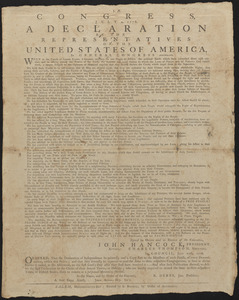
The Leventhal Map Center at the Boston Public Library has opened “Declarations: Printing a New Nation” with eight printings from broadsides and newspapers, along with maps showing the spread of that news. It will be up through 13 September. Shown here is the library’s copy of the Declaration as printed by Ezekiel Russell for the newly independent Massachusetts government.

The Boston Athenaeum exhibit “Imagined Nation” displays early printings in the context of such items as George Washington’s copy of Thomas Paine’s Common Sense, maps of the young republic, and World War II–era posters. That runs through November.

The Massachusetts Historical Society’s “1776: Declaring Independence” display, up through December, includes “handwritten copies of the Declaration by John Adams and Thomas Jefferson as well as multiple early printings, including a rare Dunlap broadside.” That was the first official presentation of the text, commissioned from printer John Dunlap by the Continental Congress in July 1776.

In Cambridge, three parts of the Harvard University library system are creating linked displays. The university archives is offering “Harvard and the American Revolution.” Next week the Harvard Map Collection will open “Charting Independence.” And starting on 18 May the Houghton Library will host “War of Words,” a display assembled by curator John Overholt to feature “the posters, pamphlets, newspapers, and images that brought news of the American Revolution to those who lived through it.”

In addition to the sites on the Declarations Trail, the Commonwealth Museum regularly displays Mary Katherine Goddard’s official reprinting of the Declaration signed by John Hancock and sent to the state in 1777.

And the “The Road to Revolution: Massachusetts and the Independence Movement” exhibit in Revolutionary Spaces’s Old State House, drawing on material from the M.H.S., includes a “rare 1776 Boston broadside printing of the Declaration of Independence.”

Most of those exhibits are free to the public. Many have special tours, talks, and workshops scheduled as well.

In a parallel initiative, five Revoloutionary-era institutions with admission fees—the Paul Revere House, Old State House, Old North Church, Old South Meeting-House, and King’s Chapel—have combined to offer visitors the Boston 250 Pass with a 10% on regular adult admission.

Thursday, May 07, 2026

A Closeup Look at the President’s House in Philadelphia

I’ve been following the story of the President’s House site within Independence National Historical Park.

That structure marks the residence of George Washington and John Adams before the District of Columbia was built and also memorializes the people enslaved to the Washingtons who lived and worked there.

In September, we first learned that White House policy was putting pressure on the park to change the signage on that site. In January, the signs were taken down.

In February, after the city of Philadelphia filed a lawsuit, a judge ordered the signs be put back up. But then a higher judge halted that process while also requiring those signs already restored to remain. The U.S. Circuit Court has upheld that stasis.

Last month I traveled to Philadelphia for the Pursuit of History’s weekend examining the creation of the Declaration of Independence. One morning I walked through the President’s House.

Most of the frames for signs are empty; the few panels that have been restored appear to be almost random. In some of the blank spaces people had posted small images of the missing signs. While I was there, a local taped a large sheet of paper in another space along with two markers, inviting people to share their own thoughts on the controversy. I presume those unofficial displays are taken down each evening and replaced each day.

In April the National Park Service unveiled new draft signage, created (by people unknown) to please the White House. Those panels now appear on the webpage for the President’s House Site. WHYY reported:
The new panels include references to slavery, the Underground Railroad and figures like Frederick Douglass. Like the previous panels, they also make mention of the nine enslaved people held by Washington while he was president and living in Philadelphia.

However, they would have changed the overall tone of the site, softening and significantly reducing references to slavery, and shifting the focus toward the “anti-slavery sentiments” of the slave-owning Founding Fathers. For example, text on one notes that the U.S. Constitution did not contain the word “slavery,” and another one argues that Washington had “doubts” about the institution.
Local critics called that revision “whitewashing” and “maliciously outrageous.”

TOMORROW: A historian’s take.

Tuesday, March 03, 2026

“Touch-screen displays, Revolutionary War artifacts, and A.I. slop”

Among the Trump administration’s Sestercentennial initiatives are modern gladiatorial games outside the White House on the President’s birthday. Less decadently imperial are the Freedom Trucks mentioned yesterday.

These trucks were clearly inspired by the Freedom Train that traveled the country in 1947–49, giving citizens a look at 127 documents from the National Archives and other artifacts.

The most detailed list of those documents that I found is a Huntington Library catalogue description of “Heritage of Freedom,” the booklet given out to explain those items to visitors. The selection didn’t include the handwritten Declaration of Independence, Articles of Confederation, or Constitution, but it did have the Congress-approved Bill of Rights, George Washington’s copy of the printed Constitution, and various letters and pamphlets from the Founding era. The display went back as far as the Magna Carta and Christopher Columbus, and as recently as the surrender of Germany and Japan.

The 1940s Freedom Train previously inspired the American Freedom Train of the Bicentennial period, 1975–76. This one carried Washington’s copy of the Constitution again, the original Louisiana Purchase, and other documents, but also one of Judy Garland’s dresses from The Wizard of Oz, Martin Luther King Jr.’s pulpit, and a Moon rock. It was like a rolling Smithsonian.

What will be in the Freedom Trucks? The New York Times reported:
The truck exhibits were designed in collaboration with Hillsdale College, a conservative school in Michigan, and PragerU, a company that makes conservative educational materials. . . . The trucks prominently feature quotes from Mr. Trump and a video he filmed inside the Oval Office.
On 27 February, the New Yorker offered a story by Jessica Winter about PragerU’s projects:
Last year, PragerU unveiled the Founders Museum, a “partnership” with the White House and the U.S. Department of Education featuring A.I.-generated video testimonials from luminaries of the American Revolution. These include a digitized John Adams who ventriloquizes the words of the right-wing influencer Ben Shapiro, almost verbatim: “Facts do not care about our feelings.”

PragerU is also supplying the multimedia content for the Freedom Truck Mobile Museums, a travelling exhibition of touch-screen displays, Revolutionary War artifacts, and A.I. slop that will chug across the country on tractor-trailers throughout 2026, in celebration of the two-hundred-and-fiftieth anniversary of the Declaration of Independence. It seems that the battle over who defines good and evil—or, at least, over who defines American history—will be waged, in part, from the helm of an eighteen-wheeler. . . .

Prager’s nonprofit is just one of dozens of conservative organizations, many of them Christian, that are named as “partners” in the America 250 Civics Education Coalition, which is overseen by Linda McMahon, the Education Secretary. The coalition has the secular task of developing programming for America’s birthday, such as PragerU’s Founders Museum and the Freedom Trucks, the latter of which received a fourteen-million-dollar grant from the federal Institute of Museum and Library Services. (In March, President Trump signed executive orders to dismantle both the I.M.L.S. and the D.O.E.; they remain alive, albeit in shrunken, ideologized versions of their former selves.)

Other America 250 partners include both of the major pro-Trump think tanks (the America First Policy Institute and the Heritage Foundation), a Christian liberal-arts school (Hillsdale College), the Supreme Court’s favorite conservative-Christian legal-advocacy group (the Alliance Defending Freedom), the Christian-right-aligned church of Charlie Kirk (Turning Point USA), and something called Priests for Life.
Another notable detail from the New York Times: “Both institutions [Hillsdale and Prager U] said that they had not received any of the $10 million in taxpayer money and that they had funded their work with private donations.” That $10 million, you may remember from yesterday, was shifted by the White House from the Institute of Museum and Library Services to America250 and then to Freedom 250, ostensibly for these very trucks. What pocket is that money sitting in now?

TOMORROW: Up in the air.